No Breakthrough in Paris Talks, Says Ukrainian Foreign Minister
No important updates took place in Paris talks, in regard of getting fragile peace deal back on board, stated Ukraine’s foreign minister on Thursday, as he stressed that until security is restored; there could be no election in the rebel-held Donbass region. Germany and France, peace deal planners,
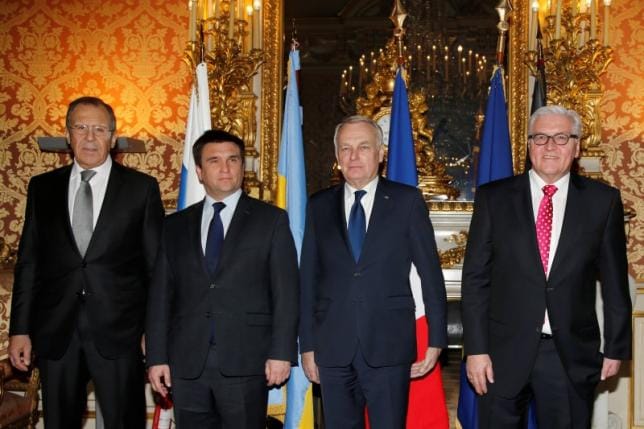
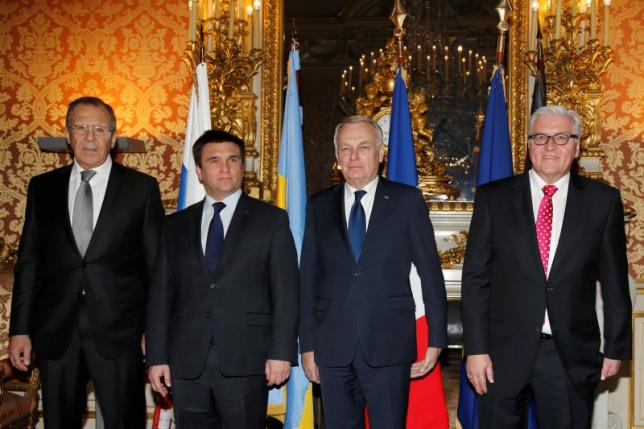
From L-R, Russian Foreign Minister Segei Lavrov, Ukraine’s Foreign Minister Pavlo Klimkin, French Foreign Minister Jean-Marc Ayrault and German Foreign Minister Frank-Walter Steinmeier pose before a meeting to discuss the Ukraine crisis in Paris, France,
No important updates took place in Paris talks, in regard of getting fragile peace deal back on board, stated Ukraine’s foreign minister on Thursday, as he stressed that until security is restored; there could be no election in the rebel-held Donbass region.
Germany and France, peace deal planners, have held out hope that with time and carefully calibrated pressure on both Ukraine and Russia the deal could be pushed back on track after progress in implementing the Minsk peace deal for eastern Ukraine has stalled, for months now.
However since a dual visit was paid by the German and French foreign ministers to Ukraine’s capital last week, an unpromising view has taken hold: that political dysfunction in Kiev has all but doomed the chances of it delivering on its own commitments under the peace agreement. The ministers met in Paris against the backdrop and rise in ceasefire violations in the east, where Ukrainian government forces are faced off against pro-Russian rebels. Little progress appeared to have been made after more than 4 hours of talk that the French Foreign Minister Jean-Marc Ayrault described as “frank, direct and without holding back”.
“No, I don’t have that impression,” Ukrainian Foreign Minister Pavlo Klimkin stated when asked if there had been a breakthrough.
While declining to comment, his Russian counterpart Sergei Lavrov had left the talks minutes earlier.
One of the meeting’s main goals was to tackle what is now seen in many European capitals as the biggest hurdle to the peace deal – Kiev’s failure to push through an election law for the Donbass region of eastern Ukraine that would set the stage for a vote there by mid-year.
Stressing on that security comes first, Klimkin stated that “The point I made specially is the necessity of providing security in the run-up to the future elections. Security first. Without security we can’t deliver on anything further”.
Ayrault sought to show there was some momentum on commitments to finally withdraw heavy weapons, abide by the ceasefire and give full access to monitors from the Organization for Security and Co-operation in Europe, and as he restated the hope of the four ministers to hold the elections by the end of June. European officials have said the goal is to keep Minsk on life support even if it doesn’t look alive. They fear that if they were to breakdown completely there is a big chance that violence could spiral, with pro-Russian separatists running amok and eventually carving out a land corridor to Russia-annexed Crimea.
Ayrault said “We know that there is work to do … but tonight we crossed an important hurdle. We will have others (to cross) but it’s the right way, the right path”.