Assad Refuses to Step Down
Beirut, Asharq Al-Awsat—Embattled Syrian president Bashar al-Assad has labeled the British government “shallow and immature” in its approach to the uprising in his country. In a television interview with The Sunday Times newspaper, Assad said Britain’s involvement in the Syria crisis had
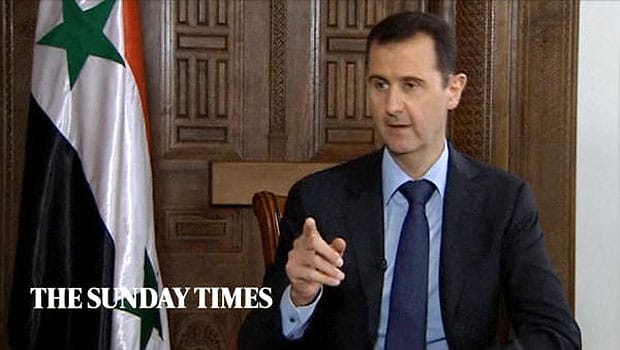
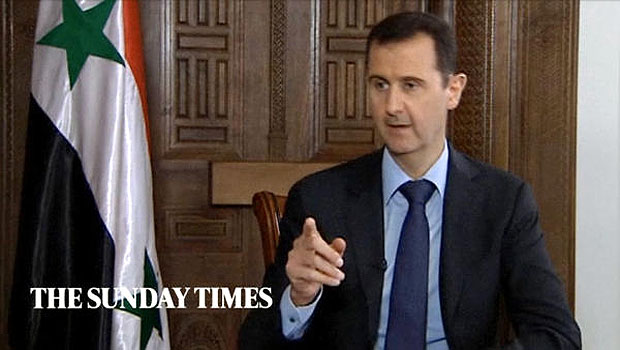
Syrian President Bashar Assad gestures while speaking during an interview with the Sunday Times, in Damascus, Syria. (AP)
Beirut, Asharq Al-Awsat—Embattled Syrian president Bashar al-Assad has labeled the British government “shallow and immature” in its approach to the uprising in his country.
In a television interview with The Sunday Times newspaper, Assad said Britain’s involvement in the Syria crisis had been naive and unrealistic.
“I think they (Britain) are working against us, and they are working against the interests of the UK itself,” Assad said in English-language remarks broadcast by Britain’s Sky TV.
“This government is acting in a naive, confused and unrealistic manner. If they want to play a role they have to change this, they have to act in a more reasonable and responsible way.”
Assad added: “How can you ask them to play a role in making the situation better, more stable, how can we expect them to make the violence less when they want to send the military supply to the terrorist?”
Assad went on to tell the Sunday Times that he will not step down or go into exile. He said he is ready for dialogue with armed rebels and militants, but only if they surrender their weapons. Recently his foreign minister offered such talks but left the question of laying down arms unanswered. Assad’s regime often refers to rebels as “terrorists.”
In the interview, Assad also vowed to retaliate against Israel for an airstrike near Damascus last month.
Backed by the United States, Britain and much of Western Europe, Syria’s opposition has made plain that Assad can play no role in a future Syrian government.
But as the situation deteriorates on the ground, the opposition is increasingly frustrated with the West’s reluctance to get directly involved in the fighting, and wants foreign powers to send weapons to help its fighters.
Syria’s conflict has already attracted hardline Sunni fighters some from Afghanistan, Libya and Chechnya, many of whom consider Shi’ites infidels and their shrines as non-Islamic symbols of paganism which should be torn down.
On Thursday, the United States said it would for the first time give non-lethal aid to Syrian rebels, describing the aid as a way to bolster the rebels’ popular support.
The assistance will include medical supplies, food for rebel fighters and $60 million to help the civil opposition provide basic services like security, education and sanitation.
Britain supports increasing general assistance to the rebels and has not ruled out supplying arms at some point in the future if the situation continued to deteriorate.
In other news, Shi’ite fighters from Iraq and Lebanon have joined fellow Shi’ite Syrian gunmen to defend a shrine south of Damascus which they fear is threatened by Sunni rebels battling the Assad regime.
The presence of Shi’ite combatants from neighboring states – confirmed by sources in Iraq and Syria and highlighted in videos glorifying their mission – underlines how Syria’s conflict is inflaming sectarian feelings in the region.
Syria’s conflict has already attracted hardline Sunni fighters some from Afghanistan, Libya and Chechnya, many of whom consider Shi’ites infidels and their shrines as non-Islamic symbols of paganism which should be torn down.